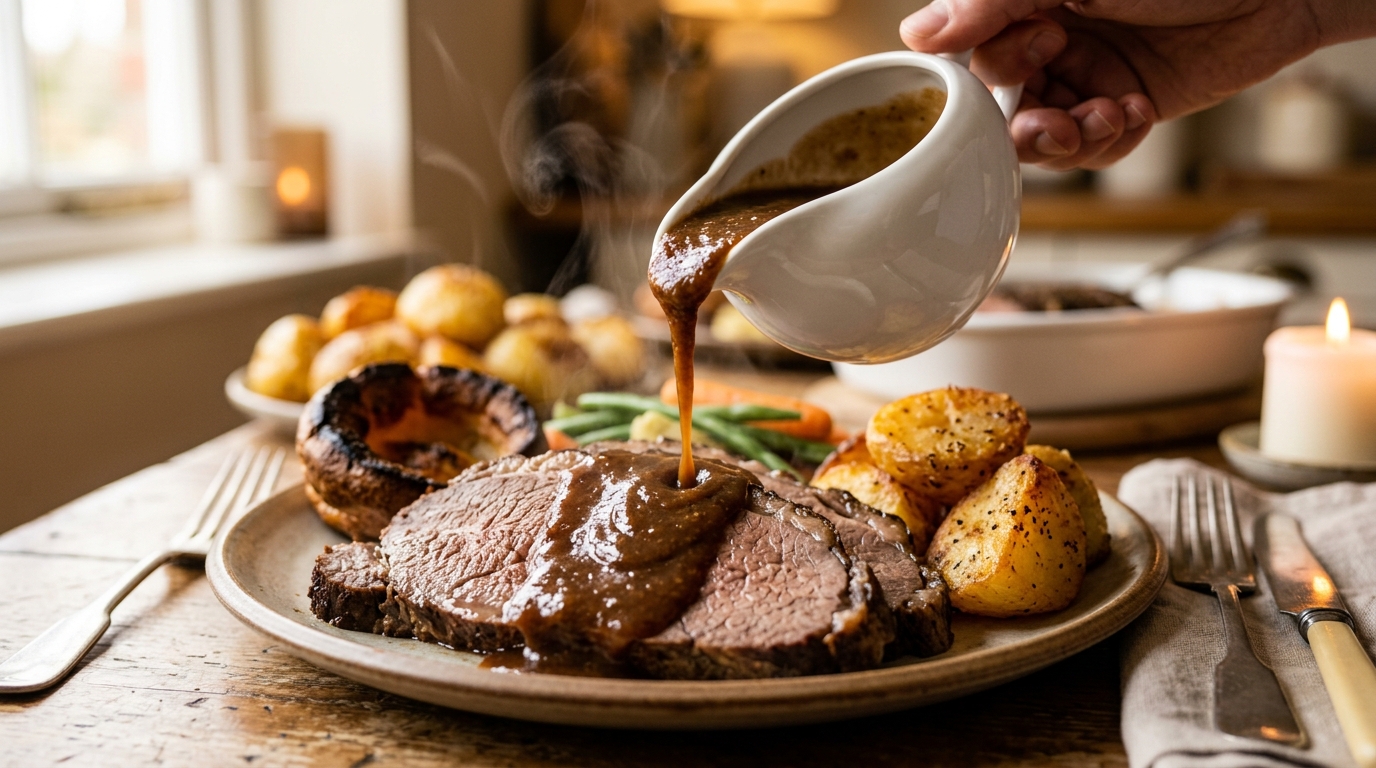
Yes, you can reheat gravy, and it usually comes out just as good as fresh. The main challenge is that gravy thickens considerably as it cools and can form a skin on top — neither of which are problems once you know what to do. Meat-based gravies (made from roasting juices) need to reach 75°C when reheated. Vegetable or packet gravies are lower risk but still benefit from a proper heat-through rather than a lukewarm warm-up.
Can You Reheat Gravy?
Yes. Gravy reheats well and the texture holds up better than most sauces. The one thing to watch with meat-based gravy is that it reaches 75°C (165°F) throughout — the same rule as any dish made from meat drippings. Store gravy in the fridge within two hours of cooking, and use it within three to four days. Gravy also freezes exceptionally well for up to three months.
How to Reheat Gravy on the Stovetop
The stovetop gives the best result because you can whisk constantly, which keeps the texture smooth and prevents any lumps from the cornflour or flour base re-setting unevenly.
- Tip the gravy into a small saucepan. If it has turned into a solid jelly in the fridge (this is normal with good meat-based gravy), that’s fine — it’ll loosen as it warms.
- Add a small splash of stock, water or the roasting juices from whatever you’re serving it with. Start with 2 tablespoons and add more if needed.
- Heat on medium, whisking continuously. The gravy will look lumpy at first and then smooth out as it warms — keep whisking through this stage.
- Once it’s bubbling gently throughout, it’s done. Taste and adjust seasoning — reheated gravy sometimes needs a pinch of salt or a dash of Worcestershire sauce to bring the flavour back up.
Don’t let it boil hard for more than 30 seconds — sustained boiling can break the emulsion in a fat-rich gravy and make it look greasy on top.
How to Reheat Gravy in the Microwave
Fast and perfectly fine for gravy, as long as you stir it properly. The microwave heats the outside of the jug first, so unstirred gravy can be scalding on the edges and barely warm in the centre.
- Pour the gravy into a microwave-safe jug or bowl. Add a splash of water or stock if it’s very thick.
- Cover loosely with a microwave-safe lid or plate to prevent splattering — gravy at full power is explosive.
- Heat on full power for 60 seconds.
- Stir thoroughly, getting right to the base. This redistributes the heat from the outer layer through the middle.
- Heat for another 30–60 seconds, stir again, and check it’s piping hot before serving.
For large volumes of gravy (a full jug), do two rounds of 60 seconds with a stir in between rather than one long blast — it heats more evenly that way.
How to Fix Lumpy Reheated Gravy
If your gravy went lumpy when you reheated it, it means the starch (cornflour or plain flour) in the thickening agent re-set unevenly. The fix is simple: whisk vigorously while it’s still hot, then push it through a fine sieve into a clean pan. A quick blitz with a stick blender also works. To prevent it next time, add a splash of liquid before reheating and whisk from the moment it starts to warm, not just at the end.
Tips for Reheating Gravy
- Always add liquid before reheating — gravy thickens in the fridge and needs 2–3 tablespoons of stock or water to come back to the right consistency without scorching.
- Whisk, don’t stir — a whisk works far better than a spoon at keeping the texture smooth as it heats.
- Taste at the end — a splash of Worcestershire sauce, soy sauce, or a small knob of butter stirred in just before serving lifts reheated gravy significantly.
- Keep the skin off — if you store gravy overnight, press a piece of cling film or baking paper directly onto the surface. This prevents the skin from forming and then going lumpy when reheated.
- Freeze in portions — gravy freezes perfectly in ice cube trays, then transferred to a freezer bag. You can defrost just what you need.
How Many Times Can You Reheat Gravy?
Once, if the gravy contains meat drippings. Meat-based gravy has the same rules as any meat dish — one reheat, then discard. Vegetable gravy or packet gravy made with just water can technically be reheated twice, but the quality suffers and it’s rarely worth it. Portion it out before storing rather than reheating the whole batch each time.
Which Method Is Best for Reheating Gravy?
| Method | Time | Result | Best For |
|---|---|---|---|
| Stovetop | 3–5 min | Smooth, full control, best texture | All gravy types, large batches |
| Microwave | 90–120 sec | Good if stirred properly | Single portions, speed |
Related Articles
- Can You Reheat Casserole?
- Can You Reheat Beef?
- Can You Reheat Lamb?
- Can You Reheat Turkey?
- Can You Reheat Food Twice?
- Can You Reheat Yorkshire Pudding?
- Can You Reheat Stuffing?
- Can You Reheat Shepherd’s Pie?
- Can You Reheat Stuffed Peppers?